

Hello everyone,
Today we start discussing a super important topic: fertility.
This will be a five part series to deep dive into our ability to conceive with my colleague Daria, a Nutritional Therapist who specialises in fertility. In these series we will answer some key questions about our fertility.
It’s my birthday on Tuesday and I would love to give you a 20% discount on the paid version of The PCOS Newsletter. Available till 19th of February only. We have some incredible content coming up on top of our fertility series, including interviews with GPs and Gynaecologists. Don’t miss out on this offer.
I know this is a worry for all of the women with PCOS. We hear about the probability of struggling to become pregnant from early on. It’s a worry for me.
In addition to our struggles with fertility, there is also the annoying clock. Unfortunately finding the right husband it’s a bit trickier these days. If you have not found him at university or college, you are likely to be pushed with dating in your late twenties. By the time marriage comes along it will be early thirties. Unfortunately this age it’s also the time when your career picks up. You have enough experience to go up the ladder. With that comes access to more income which opens the doors to travelling and adventure. For me, the decision to have a baby now in my early thirties it’s though. I think I want to have children but I don’t want to give up my great life. Anyone feels the same?
In today’s insightful conversation we discuss if and how you can find out your fertility status and why women with PCOS might struggle with fertility.

In this article and video:
Who is Daria?
What is Nutritional Therapy in PCOS?
Why do women with PCOS struggle with fertility?
How do androgens impact fertility?
How do I know how much time I have left?
How does age impact fertility?
How long before planning should I prepare?
How do I know how much time he has got left?

Who is Daria?
Daria is Nutritional Therapist specialising in Fertility. She is a lecturer and academic tutor at CNM and a good friend of mine.

You can find Daria at www.nutridaria.com, Instagram or email at: daria@nutridaria.com
What is Nutritional Therapy in fertility?
Nutritional therapists working in the realm of fertility prioritise two aims:
Getting the couple to optimal health
Replenish nutrients stores for a health baby
Rather than focusing solely on the woman, the approach emphasises that fertility is a shared journey, where both parties must be in optimal health. As a result we look at both the women and the man and address any imbalances.
We leverage food and lifestyle as primary tools for health improvement. An essential aspect of the approach involves replenishing critical nutrients—such as iron, which plays a vital role in supporting the increased blood volume demands during pregnancy and preventing anemia. Addressing nutrient deficiencies prior to conception is crucial because correcting them during pregnancy can be significantly more challenging. Overall, the strategy is to prepare the couple holistically, reducing potential health risks and paving the way for a successful and healthy pregnancy journey.
Why do women with PCOS struggle with fertility?
Pregnancy can only happen when there is release of an egg from an ovary, a phenomenon called ovulation. There is a relatively small window of time around ovulation, called fertility window, when sperm has to be present in the female genitourinary tract for conception to occur. What can make it more challenging for women with PCOS to get pregnant is irregular ovulation patterns. Essentially we can’t predict when you should have intercourse in order for pregnancy to happen. It is important you understand why ovulation fails in women with PCOS to get the full picture of fertility.
You can read it here:

or watch it here:
In addition to irregular periods, women with PCOS might have a lower quality eggs. Insulin resistance, a common feature of PCOS, can lead to oxidative stress, which damages eggs and impairs their developmental potential. Elevated androgen levels interfere with follicular development. It has also been shown that the follicular fluid in some women with PCOS shows a pro-inflammatory environment, increased oxidative stress, and metabolic disturbances which can adversely affect oocyte quality and preimplantation embryo development.
Overall, some of the drivers of our PCOS symptoms doesn’t create the right type of environment for pregnancy. This is why working on our health is a non-negotiable if we want to have a baby.
How do I know how much time I have left?
If you come to your doctor and ask to assess how much time you have left to conceive they are most likely to perform testing of the ovation reserve.
Your ovarian reserve refers to the quantity and quality of your remaining eggs. To measure your ovarian reserve, we have a few methods:
Anti-Müllerian Hormone (AMH): AMH is a hormone produced by granulosa cells in ovarian follicles and can be measured in a blood test. AMH level reflects the number of eggs that are present in the ovary and is therefore used to predict ovarian fertility potential and ovarian response to fertility drugs.
Antral Follicle Count (AFC): AFC refers to the number of small follicles (2-10 mm in diameter) visible on an ultrasound, typically measured early in the menstrual cycle, giving insight into your ovarian reserve.
Follicle-Stimulating Hormone (FSH): A basal (day 2–4) FSH concentration is an indirect marker of ovarian reserve based on feedback inhibition of pituitary FSH secretion. High FSH levels can indicate diminished ovarian reserve, but in PCOS, FSH is often normal or low.
Women with PCOS often have elevated AMH levels and a higher antral follicle count (AFC) due to the high number of small and immature follicles, but this doesn’t always indicate good egg quality making it challenging to use AMH and AFC at a face value. Increased ovarian reserve markers like antral follicle counts and anti-Müllerian hormone levels in PCOS do not necessarily translate to a lengthened reproductive lifespan. It’s important to highlight that both AMH and AFC do not directly assess egg quality or the likelihood of successful pregnancy. Unfortunately, there is no direct method of measuring egg quality at the moment.
Overall, it challenging to know how much time you have left for any women. It is even more challenging for us, those with PCOS. If your PCOS is relatively controlled and its severity mild, the above methodologies could give you an indication of where you are standing with your PCOS.
How does age impact fertility?
Oocyte number and quality decline with age; however, fertility varies significantly even among women of the same age. In general fertility starts to decline in women of 30 years of age with an accelerated decline starting around 35-37 years with a more pronounced effect >40 years.
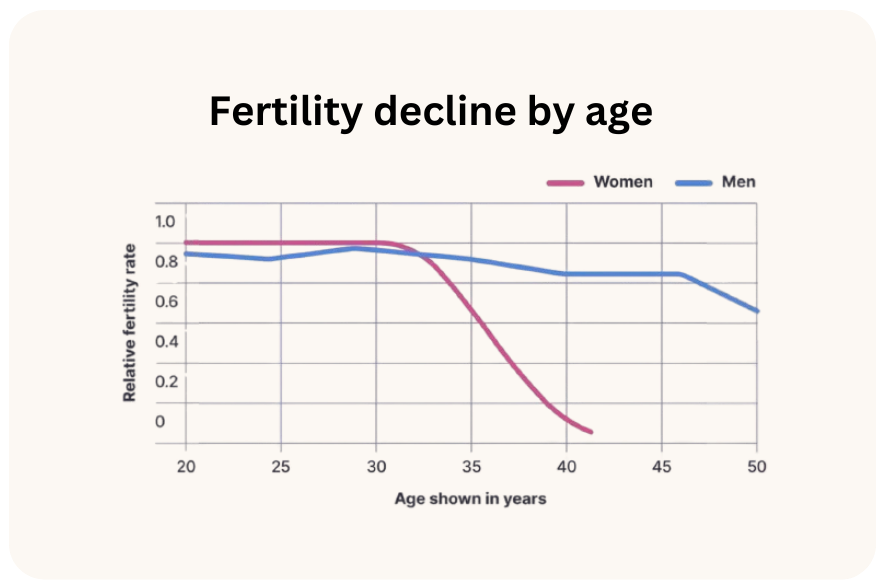
While PCOS doesn’t directly accelerate the natural decline in egg quality with age, time remains a critical factor. Whilst some research suggests women with PCOS could retain their ovarian reserve longer than those without the condition, other data show that women with PCOS face similar age-related declines in fertility.
How long before planning should I prepare?
The earlier you start, the better. Ideally, aim to begin preparation at least 3 to 6 months before trying to conceive. This time frame gives your eggs the chance to mature in an optimal environment. It takes 3 months for a follicle to develop so we want to give it the best chance. If you have less time, don’t worry as any amount of preparation is beneficial. We will delve deeper into this topic in our next episode.
How do I know how much time he has got left?
It’s a 50% 50% job to make a baby. Even though we do much more of the work of actually delivery the baby, for its conception we need the sperm health to be as good as our health.
For man, fertility also declines with age, even though not as rapid as ours. To understand your partner’s fertility:
Semen analysis - this involves a sample of your partner’s semen being tested to check the amount of sperm in it. The test also checks how fast the sperm move and the shape of the sperm.
Semen DNA fragmentation - The human sperm cell, in fact, is not just responsible for the expression of the father’s genes but also for activation and the development of the embryo during and after implantation. This test checks for any problems in the DNA material.
We will also delve deeper into this topic in Episode 3.
I hope this has allowed you to get a little insight into why fertility might be challenging for us.
See you next Sunday,
Francesca1
Disclaimer: We are all unique in our ways, so this information is for educational purposes only. In my communications, I summarise research data and bring my experience. This shouldn’t be viewed as medical advice at any point. Please consult your healthcare provider further about your health needs.


