

Hello everyone,
Excess testosterone is one of the main drivers of some of our most annoying symptoms: excess hair, irregular periods, acne, weight gain, and inflammation.
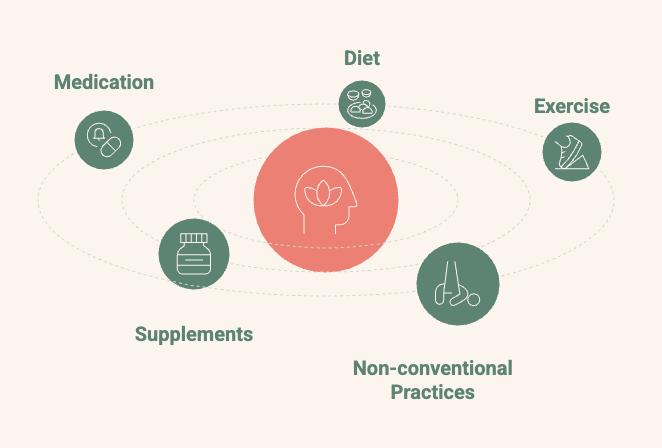
In this article, I want to focus on offering the most comprehensive scientific way to lower testosterone so you can tackle this challenge from multiple angles. We will be looking at: medication, diet including specific foods, exercise, supplements and some surprising non-conventional practices.
There are both genetic and environmental factors that drive high androgens in women with PCOS. Excess insulin is one of the main drivers that can increase our levels; therefore, lifestyle will, of course, be a topic of discussion. I won’t go into too much detail on why we have high androgens and the different types, but I will leave here the in-depth articles that explain it:


I will use Androgens and Testosterone interchangeably in this article for simplicity's sake.

Diet
I am a Nutritionist, so diet and food will always be my first recommendation. It’s the foundation of our health and we must treat it with the importance that it deserves.
When it comes to evidence about the best foods or diet to help lower testosterone, the Mediterranean diet tops my preferences and has scientific backing. A cross-functional study in 2019 identified three factors: the consumption of monounsaturated fatty acids (MUFA), complex carbohydrates, and fibre, which were directly correlated with lowering testosterone levels. These come down to their anti-inflammatory superpowers. Fibre from complex carbohydrates leads to the production of short-chain fatty acids, which are key substances for our metabolic health. Additionally, the high intake of polyunsaturated fatty acids (PUFA), omega-3, and antioxidants found in fruits, vegetables, extra-virgin olive oil, and wine helps lower the inflammation associated with high testosterone levels.
Due to insulin's effect on testosterone levels and the fact that excess fat increases the conversion of less potent androgens into more powerful ones, all energy-restricted diets have been shown to lower androgen levels. Losing weight does help. Focusing on high-nutrient foods with a moderate 300-400 calorie deficit will show its power in 3-6 months.
When it comes to specific foods that you can add to your diet, there is some evidence for the following:
Soy isoflavones found in tofu, tempeh, edamame, soy milk, miso, and soy yoghurt have been shown to lower testosterone levels - I am personally a big fan
Cinnamon - cinnamon is thought to help lower insulin levels and, as a result, impact testosterone levels → my view on this is that cinnamon won’t solve all our problems; however, adding it won’t harm if you like the taste and you can incorporate it into your diet.
In the drinking category, some teas have shown positive trends in impacting this annoying hormone:
Spearmint tea → I was actually quite shocked to see the evidence behind this, but some studies show that drinking spearmint tea can lower testosterone, plus it’s a lovely drink if you like mint.
Green tea → the superpowers of green tea come from catechins, which are thought to protect against cellular damage, and as a result lower inflammation
These are some great things we can implement in our day-to-day to counteract the genetic PCOS makeup we inherited.
Exercise
Resistance training shows evidence for reducing androgens. Let’s grow some muscles!! I found resistance training 1 and a half years ago, and it has forever changed my body composition and symptom management.
A 2020 meta-analysis by Patten et al. found that resistance training led to greater improvements in androgen levels compared to moderate or vigorous aerobic exercise, especially when combined with dietary intervention and after ≥50 hours of training. That is about 16 weeks of 45-minute sessions x 4 times a week. I want to emphasise that exercise and diet take time to show on your body, but once they are there, they build an incredibly strong foundation for your long-term health. It can feel like an uphill battle when you first start, but once it becomes a lifestyle, your PCOS will change.
On the other hand, there is also evidence that HIIT (high-intensity interval training) can lower testosterone levels. A 2022 randomised controlled trial by Rao et al. directly compared 12 weeks of HIIT versus strength training in women with PCOS. HIIT was significantly more effective than strength training in lowering serum testosterone levels and body fat percentage.
My recommendation is always to mix and match things → doing strength training with one session of HIIT or cardio will allow you to both develop your muscles and also your cardiovascular health. In addition, finding ways that you enjoy is above all the most important. Enjoying it means you will do it for longer and more consistently.
Lastly, for any yoga lovers, studies show that yoga can help lower testosterone, so sneaking in a yoga session a week between strength training and cardio can add a little boost.
Medication
As you probably know by now, there is no medication explicitly licensed for the treatment of PCOS. Medications that have been developed for other conditions are used in PCOS because of their effect on our symptoms.
The 2023 International PCOS Guidelines recommend contraceptives as first-line therapy for hyperandrogenism.
The current consensus is the following:
“Current evidence does not support the use of anti-androgens preferentially to COCPs to treat hyperandrogenism in PCOS. Anti-androgens could be considered to treat hirsutism in PCOS, where COCPs are contraindicated, poorly tolerated, or present a sub-optimal response after a minimum 6-month period, with consideration of clinical context and individual risk factors and characteristics.”
In addition to the pill, Metformin could also be prescribed for PCOS. Its insulin-reducing effect will also lower testosterone levels.
Specific anti-androgenic medication will be prescribed in more severe cases, and they could be:
1. Spironolactone can be prescribed for the management of acne and hirsutism. I have an in-depth article here about this medication:

Cyproterone or Flutamide - both medications developed to treat prostate cancer. One blocks testosterone from binding to androgen receptors, and the other one stops the conversion to a more potent androgen.
Finasteride - designed to treat benign prostatic hyperplasia (BPH), the enlargement of the prostate in men, it blocks androgen receptors in hair follicles and sebaceous glands.
As you can see, these are powerful medications designed primarily for men, so please be cautious about them. Please be under strict observation from well-trained doctors before considering taking some of these medications.
Supplements
Here we go:
Inositol - our favourite supplement and the most studied in women with PCOS - Inositol has been shown to lower testosterone. An in-depth article on Inositol, including dosages and formulations:

Berberine - very similar action to Inositol and Metformin, Berberine helps manage insulin levels, which will have an impact on testosterone levels. An in-depth article can be found here:

Zinc - essential for insulin synthesis, release, and action
and storage. It has been shown to me that lower levels of zinc in women suffering from acne and supplementation with zinc can ameliorate these symptoms.

Other supplements that will indirectly support your testosterone levels, while helping your overall health and managing PCOS, are Omega-3 and Vitamin D. I personally take these regularly.
Also, please be cautious with supplements. A 2025 meta-analysis looking at 33 supplements, 79 RCTs involving 5501 participants, found that no nutritional supplement produced a statistically significant reduction in total testosterone (TT), sex hormone-binding globulin (SHBG), dehydroepiandrosterone sulfate (DHEAS), or free androgen index (FAI). Some studies find differences, and some don’t.
My interpretation of this is the following: supplements will help with the foundation of diet and movement, but they won’t solve our problems on their own → they do what it says on the tin SUPPLEMENT.
Other
Certain cultures in the world use more than just Western Medicine to treat conditions such as PCOS. Chinese medicine has been used for centuries, and studies are now emerging showing the power that some practices can have.
In a review of 21 studies with 1,196 participants, Electroacupuncture has been shown to reduce testosterone levels. Electroacupuncture is a form of acupuncture that uses electrical stimulation to enhance the therapeutic effects of needles inserted into the body. A low-level electrical current is passed between pairs of acupuncture needles to stimulate specific points.
In addition, managing stress is probably one of those interventions that everyone tells you about. However, in lowering testosterone levels, managing cortisol is even more important due to the adrenals’ impact on androgen production. You probably know better what makes you relax, so practising that regularly will help keep your nervous system regulated and give your body the chance to act in homeostasis (balance).
I hope this has given you new ideas on what to incorporate in your management plan. PCOS must be managed from multiple angles, and creating a plan that suits you and your body is the treatment for this condition. If you need individual support, I offer one-to-one consultations, so don’t hesitate to get in touch.
See you next Sunday,
Francesca
Barrea, L., Arnone, A., Annunziata, G., Muscogiuri, G., Laudisio, D., Salzano, C., Pugliese, G., Colao, A. and Savastano, S. (2019) ‘Adherence to the Mediterranean Diet, Dietary Patterns and Body Composition in Women with Polycystic Ovary Syndrome (PCOS)’, Nutrients, 11(10), p. 2278. doi:10.3390/nu11102278.
Zilaee, M., Mansoori, A., Seyed Ahmad, H., Mohaghegh, S.M., Asadi, M. and Hormoznejad, R. (2020) ‘The effects of soy isoflavones on total testosterone and follicle-stimulating hormone levels in women with polycystic ovary syndrome: a systematic review and meta-analysis’, European Journal of Contraception & Reproductive Health Care, 25(4), pp. 305-310. doi:10.1080/13625187.2020.1761956.
Sirmans, S.M. and Pate, K.A. (2013) ‘Epidemiology, diagnosis, and management of polycystic ovary syndrome’, Clinical Epidemiology, 6, pp. 1-13. doi:10.2147/CLEP.S37559.
Asemi, Z., Samimi, M., Heidarzadeh, Z., Khorrammiyan, A. and Tabassi, Z. (2014) ‘The effects of DASH diet on weight loss, insulin sensitivity, and cardiovascular risk factors in overweight and obese women with polycystic ovary syndrome: a randomized controlled clinical trial’, Reproductive Biology and Endocrinology, 12, p. 77. doi:10.1186/s12958-021-00831-z.
Ejtahed, H.S., Bahmanpour, Z., Shafiei, F., et al. (2020) ‘Probiotic yogurt improves antioxidant status in women with polycystic ovary syndrome: A randomized controlled clinical trial’, Clinical Nutrition, 39(12), pp. 3733-3739. doi:10.1016/j.clnu.2020.06.043.
Kazemi, M., McBreairty, L.E., Chizen, D.R., et al. (2022) ‘Physical activity, sedentary behaviour, diet, and bone health in women with polycystic ovary syndrome: a systematic review and meta-analysis’, Journal of Clinical Medicine, 11(15), p. 4438. doi:10.3390/jcm11154438.
Jin, P. and Xie, Y. (2023) ‘Efficacy and safety of anti-androgens in the management of polycystic ovary syndrome: a systematic review and meta-analysis’, Journal of Clinical Endocrinology & Metabolism, 108(9), pp. 2565-2580. doi:10.1210/clinem/dgad338.
Zou, G., Ding, Q., Luo, N., et al. (2024) ‘The effectiveness of various exercise interventions for women with polycystic ovary syndrome: a systematic review and network meta-analysis’, Journal of Endocrinological Investigation, 47(5), pp. 1105-1117. doi:10.1007/s40618-023-02118-8.
NHS (2025) ‘Treatment: Polycystic ovary syndrome (PCOS)’, NHS. Available at: https://www.nhs.uk/conditions/polycystic-ovary-syndrome-pcos/treatment/.
Wang, X., Ren, Y., Wang, H., et al. (2024) ‘Effects of combined lifestyle intervention on reproductive and metabolic outcomes in women with PCOS: a systematic review and meta-analysis’, International Journal of Endocrinology, 2024, p. 6645249. doi:10.1155/2024/6645249.
Sarkar, U., Basu, S., Gupta, A., et al. (2024) ‘Efficacy of dietary approaches in managing hyperandrogenism in PCOS: a systematic review’, Nutrients, 16(6), p. 914. doi:10.3390/nu16060914.
Jia, J., Su, Y., Sun, Y., et al. (2025) ‘The effects of different interventions on free and total testosterone levels in women with PCOS: a systematic review and network meta-analysis’, Frontiers in Endocrinology, 16, p. 1298748. doi:10.3389/fendo.2025.1298748.