

Hello everyone,
The evidence on Inositol got a bit stronger.
In this article, I am covering:
The latest research paper on Inositol - February 2026
How inositol actually works for PMOS.
The latest research
A recent study was published in February 2026 looking at 13 meta-analyses of RCT. This is essentially summing up the past decade of research on inositol for PMOS.
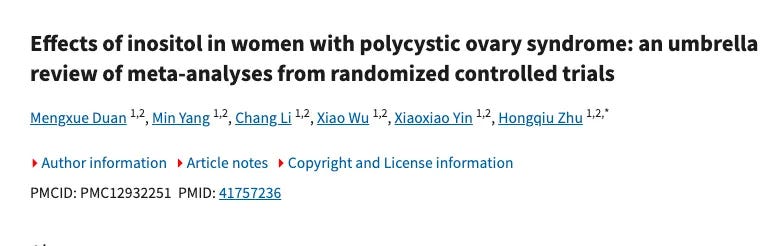
Here is what it found:
A system called GRADE, which is a way to evaluate the quality and certainty of research, was used to evaluate the meta-analyses- none of them reaches a high rating, with most of them being of moderate to low certainty.
Moderate evidence has been found for the potential of inositol to:
decrease total and free testosterone,
increase SHBG,
decrease insulin resistance (HOMA-IR),
increase ovulation rate,
increase pregnancy rate.
The evidence is somewhat lower for live births, LH, FSH, cholesterol, and weight loss.
In terms of formulation, Myoinositol 2-4g/day, with or without folic acid, seems to have the strongest evidence. Also, it has been taken for 12-24weeks to actually see results. A study showed that a significant increase in serum SHBG was observed only in those studies where MI was administered for at least 24 weeks, but not for 16 weeks.
What is inositol
Inositol is a family of 9 molecules, naturally occurring in our body but also available to us through food. The two inositols that are of most interest to us are Myo-inositol (MI) and D-chiro-inositol (DCI).
They can be found in significantly high concentrations in the brain, blood, adipose tissue, kidneys, lungs, ovaries, and testes. Our kidneys make 4 g of MI per day. Whilst we can get it from food, our body is able to make it itself.
In most tissues there is a ratio of 40:1 of MI:DCI. DCI originates from MI via an enzyme called epimerase.
What does inositol do in the ovary?
Quick recap of how an egg gets ready for ovulation:
LH tells a part of the follicle to make androgens (testosterone-type hormones). FSH tells another part of the follicle to grow and get ready to make estrogen. Those androgens are then handed over to the FSH part, which turns them into estrogen, and that estrogen keeps the follicle growing.
In the ovary, MI supports FSH signalling. On the other hand, DCI is involved in the production of testosterone.
The ratio of MI:DCI in the ovary is usually 100:1, however in women with PCOS it has been reported to be 0.2:1. We are essentially deficent. It is thought that higher levels of insulin push the ovary to convert too much MI to DCI. Studies looking at the ovary of women with PCOS found a higher activity of the enzyme that converts MI to DCI (epimerase). When MI is depleated, the FSH signalling becomes less efficient.
Essentially, we are left with MI (pro‑FSH), which is low, and DCI (pro‑androgen), which is high, leaving the balance to tip strongly towards androgens and against estrogens in the follicle, leading to a failed ovulation.
This is mainly down to excess insulin in the blood creating this imbalance.
What does inositol do in glucose metabolism?
When we discuss glucose metabolism, we are looking at how the body handles glucose. There are three organs that specifically handle this job: the muscles, the liver and fat cells. So when someone mentions insulin resistance, these are the organs we can consider (the pancreas is also involved, but it is less relevant to this conversation).
Quick recap of glucose metabolism:
For glucose to enter our muscle and fat cells, it needs insulin. Insulin can bind to specific receptors and trigger a signalling cascade involving messengers that recruit GLUT4. GLUT4 are a glucose transporter that lives in the cell and needs to be called to go to the surface and open up the gates for glucose.
The signalling discussed above requires inositol to function properly. The step I am mentioning is called PI3K, and it’s one of many steps required to get the GLUT4 to the surface. By doing this, it helps with glucose metabolism, hence improving all of the insulin-related markers above.
Overall, this supplement is the one most studied for PMOS and from what I see, it has some considerable evidence and rationale behind it.
I hope you enjoyed this deep dive,
See you next Sunday
Francesca
Aghajani, T., Arefhosseini, S., Ebrahimi-Mameghani, M. and Safaralizadeh, R. (2024) ‘The effect of myo-inositol supplementation on AMPK/PI3K/AKT pathway and insulin resistance in patients with NAFLD’, Food Science & Nutrition, 12(10), pp.7177–7185. doi: 10.1002/fsn3.4267.
Concerto, C., Chiarenza, C., Di Francesco, A., Natale, A., Privitera, I., Rodolico, A., et al. (2023) ‘Neurobiology and applications of inositol in psychiatry: a narrative review’, Current Issues in Molecular Biology, 45, pp.1762–1778. doi: 10.3390/cimb45020113.
Corbould, A., Kim, Y.B., Youngren, J.F., Pender, C., Kahn, B.B., Lee, A. and Dunaif, A. (2005) ‘Insulin resistance in the skeletal muscle of women with PCOS involves intrinsic and acquired defects in insulin signaling’, American Journal of Physiology-Endocrinology and Metabolism, 288(5), pp.E1047–E1054. doi: 10.1152/ajpendo.00361.2004.
Duan, M., Yang, M., Li, C., Wu, X., Yin, X. and Zhu, H. (2026) ‘Effects of inositol in women with polycystic ovary syndrome: an umbrella review of meta-analyses from randomized controlled trials’, Frontiers in Endocrinology, 17, 1741509. doi: 10.3389/fendo.2026.1741509.
Dunaif, A., Wu, X., Lee, A. and Diamanti-Kandarakis, E. (2001) ‘Defects in insulin receptor signaling in vivo in the polycystic ovary syndrome (PCOS)’, American Journal of Physiology-Endocrinology and Metabolism, 281(2), pp.E392–E399.
Dunaif, A., Xia, J., Book, C.B., Schenker, E. and Tang, Z. (1995) ‘Excessive insulin receptor serine phosphorylation in cultured fibroblasts and in skeletal muscle: a potential mechanism for insulin resistance in the polycystic ovary syndrome’, Journal of Clinical Investigation, 96(2), pp.801–810. doi: 10.1172/JCI118126.
Heimark, D., McAllister, J. and Larner, J. (2014) ‘Decreased myo-inositol to chiro-inositol (M/C) ratios and increased M/C epimerase activity in PCOS theca cells demonstrate increased insulin sensitivity compared to controls’, Endocrine Journal, 61(2), pp.111–117. doi: 10.1507/endocrj.EJ13-0423.
Unfer, V., Carlomagno, G., Papaleo, E., Vailati, S., Candiani, M. and Baillargeon, J.P. (2014) ‘Hyperinsulinemia alters myoinositol to D-chiroinositol ratio in the follicular fluid of patients with PCOS’, Reproductive Sciences, 21(7), pp.854–858. doi: 10.1177/1933719113518985.
What I find interesting is how the evidence supports a more nuanced view of inositol than the usual “insulin resistance supplement” framing, it appears to sit at the intersection of metabolic and reproductive signalling. The uncertainty around formulation, duration, and evidence quality is also a useful reminder that biological plausibility can explain why something might work without telling us exactly who will benefit or how much.
Great to get a tangible, but scientifically sound deep dive into the mechanism! I take a 40:1 supplement of MI:DCI. It's been a game changer, and makes so much sense given the natural presence of epimerase in tissues.