

Hello everyone,
September is PMOS Awareness Month, and there are some things I wish we shouted louder about.
What would you like to hear more about this PMOS Awarness month?
(Comment below)
Let’s get straight into it:
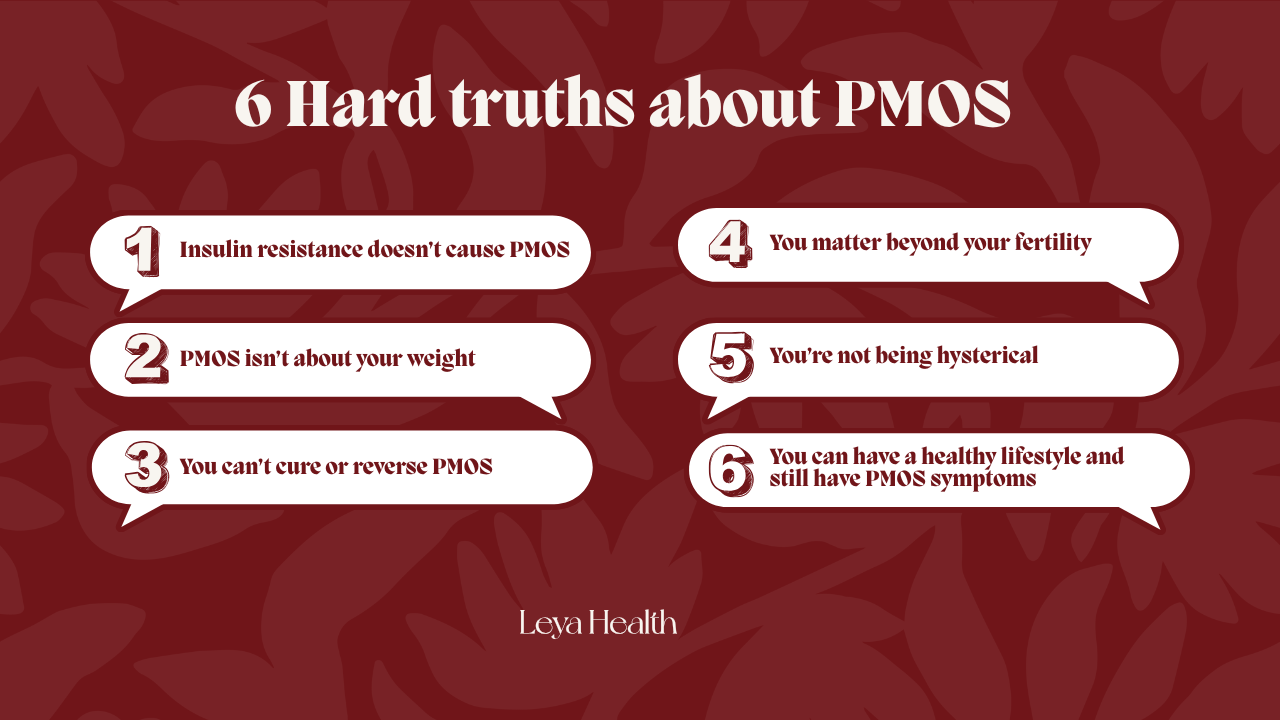
1. Insulin resistance doesn’t cause PMOS
You see this framing a lot in supplement recommendations, in health frameworks, in consultations. The idea that if you address insulin resistance, you’ve addressed the root of PMOS.
PMOS is a complex condition involving multiple organs and pathways. Insulin resistance plays a role in how it shows up for some people but but it’s not causative.
The science here:
PMOS has a strong genetic component. Twin studies show concordance rates around 72–80%, suggesting genetic predisposition is primary. If insulin resistance caused PMOS, we’d expect to see PMOS develop in people without genetic susceptibility when they became insulin resistant. That’s not what we observe. The prevalence of PMOS in type 2 diabetic women is somewhere around 20%.
What we do see: people with genetic PMOS susceptibility develop varying degrees of insulin resistance depending on metabolic context, lifestyle, and hormonal environment. Insulin resistance shows up in roughly 50–70% of people with PMOS, but prevalence isn’t the same as causation.
I break this down in our upcoming course about PMOS “The full picture”
PMOS involves disturbances across multiple systems: the hypothalamic-pituitary axis (which affects GnRH pulsatility and FSH/LH ratios), the ovaries themselves (altering how they develop follicles and produce androgens), systemic inflammation, and metabolic processing. Insulin resistance co-occurs with PMOS and may amplify certain presentations, particularly androgens. But it’s not the root sitting at the base of everything.
What happens when this gets simplified:
When Instagram and people without qualifications frame insulin resistance as the cause, the logic becomes: fix insulin by going on a diet and fix PMOS. Not only does this put the responsibility on the individual to solve this complex condition, but it also leaves people lost when “nothing” works.
2. PMOS isn’t about your weight
Women with a normal BMI have PMOS. Women with higher BMIs have PMOS. Both presentations are real.
Yet somehow the condition has become almost interchangeable with weight management. Weight loss gets framed as the treatment and the thing that will regulate cycles, restore fertility, solve the problem.
The science here
A recent paper shows us something super interesting. A lot of the time, when we do research, they select PMOS women from known clinics (usually IVF) or people who are in a certain database - calling it a selected population. However, when looking at a random, unselected population 58% of women with PMOS had a normal BMI,18.5% were overweight, and 11.7% were obese
What the research does show: weight can affect how severe symptoms become in someone who already has PMOS. If someone has the condition, carrying extra weight may worsen insulin resistance, increase androgens, and amplify cycle irregularity. So weight loss can sometimes improve outcomes. But it’s important to understand why: people eat better and move more, so they have better insulin control. In addition, the food they eat carries more antioxidants and nutrients for our body to function well. The reduction in fat cell volume can also help but it’s usually the behaviours we should be focusing on.
How this narrative developed:
Historically, much of the PCOS literature conflated it with metabolic syndrome, obesity, and insulin resistance. A lot of early research was conducted in clinic populations that skewed toward heavier people. The data got interpreted backwards: obesity is associated with PCOS, therefore obesity causes PCOS. But association and causation aren’t the same thing, and you have to account for selection bias, the fact that the studies drew from particular populations.
There’s also a practical reason the narrative persists: it’s simpler to tell someone to lose weight than to explain hypothalamic dysfunction, altered ovarian steroidogenesis, adrenal androgen excess, and genetic expression. Weight is visible and actionable in a way hormonal pathways aren’t.
What this means clinically:
The focus on weight shifts attention away from hormonal assessment. A lean PMOS patient gets told her condition isn’t “really” PCOS because she doesn’t fit the weight stereotype. A heavier patient gets told to diet her way to a diagnosis when what she actually needs is androgen measurement, ovulatory assessment, and possibly pharmaceutical or other interventions weight loss alone won’t provide.
Someone can be at a healthy weight and still have high androgens, absent cycles, and polycystic ovaries. The condition is still there. The hormonal dysfunction is still happening. It’s just not being recognized because the focus is on the wrong variable.
3. You can’t cure or reverse PMOS
PMOS has a genetic basis. Twin and family studies consistently show heritability: when one identical twin has PCOS, the other has a 72–80% chance of also meeting diagnostic criteria. That genetic predisposition doesn’t disappear.
“Genetic” in this context means: there’s a heritable vulnerability in how your ovaries develop, how your hypothalamic-pituitary axis functions, how your adrenals respond, and how your metabolic tissues process signals. It doesn’t mean your genes are permanently switched on in an unmodifiable way. Epigenetic factors such as environmental inputs, hormonal changes, and metabolic shifts do influence how that genetic susceptibility gets expressed. But the underlying susceptibility remains.
This is true for most complex genetic conditions: type 2 diabetes, heart disease, many cancers. You can improve outcomes significantly through intervention. You can’t erase the genetic predisposition.
What would reversal actually require:
To reverse PMOS, you’d need to fundamentally alter genetic expression patterns across your ovaries, pituitary, adrenal tissue, and metabolic system. No intervention we have — supplement, diet, exercise protocol — does that.
What interventions can do: manage symptoms. Birth control regulates cycles. Metformin or GLP-1 agonists improve insulin sensitivity and reduce androgens. Spironolactone lowers free androgens. Nutrition and movement improve metabolic function and reduce inflammation. These are real tools. They’re symptom management, not reversal of the condition.
What happens when the intervention stops:
When someone stops metformin, the pill, or a supplement, their cycles often go irregular again. Androgens rise. Symptoms return. The intervention was managing the symptoms. The condition was still there.
Studies tracking women off treatment show return to baseline hormonal patterns. Women who lose weight and regain it see insulin resistance return. Women who take supplements then stop see androgens climb back. This isn’t failure. It’s proof that you can’t just reverse something that was altered potentially in the womb or before that.
Why “reversal” claims persist:
The reversal story sells well. It’s more appealing than “you can learn to manage this long-term.” Someone will inevitably claim they’ve reversed their PMOS, usually while selling a supplement or program. The claim feels more hopeful than the actual picture.
But when it doesn’t happen for you, when you stop the supplement and your symptoms return, or you get to the “ideal” weight and your cycles still don’t regulate the interpretation becomes internal. You must have done it wrong. Stopped too soon. Didn’t stick to it. Weren’t “healed” yet.
That’s a particular kind of exhaustion. The endless search for the right protocol. The belief that the right combination, the right effort, will erase it. And when it doesn’t, the blame settles on you.
The alternative:
When you stop chasing a cure and reframe PMOS as a condition you’ll manage long-term, something shifts. You’re not looking for eradication. You’re building a system that works. You’re learning what helps your body. You’re not waiting to be healed, you’re building agency over your own management.
The goal becomes sustainable. You’re not trying to become someone else. You’re learning to live well with who you are.
4. Your hormones matter beyond fertility
“I want you to treat me beyond my fertility.”
I’ve heard this more than once. It comes from a particular frustration: the experience of having hormonal issues acknowledged only in the context of trying to conceive.
You mention irregular cycles. You’re asked, “Are you trying to conceive?” When the answer is no, the conversation often shifts. The hormonal issue becomes less pressing, or disappears from the clinical picture entirely.
But a regular cycle isn’t just a fertility concern. It’s a health marker. Hormone balance affects metabolic function, mental health, bone density, cardiovascular risk, quality of life. An absent or severely disrupted cycle signals something systemic is out of balance. That matters regardless of whether you want to have children.
Framing hormonal health as reproductive health misses why cycles matter to begin with. It also means people without fertility goals often get deprioritised — their hormonal health treated as less clinically urgent.
5. You’re not being hysterical; you’re being dismissed
“I know my body better than you.”
It’s a simple statement. But it’s also asserting something that should be obvious: the person living in a body has knowledge that no scan, blood test, or degree can replace.
What actually happens is more common than it should be: someone describes symptoms and is told they’re overthinking. They track patterns and are told they’re imagining them. They come in with research and are positioned as an anxious patient grasping for answers.
This pattern exists across women’s health, but shows up particularly around PMOS. The condition is complex, presentations are varied, and that complexity sometimes becomes an excuse for minimal engagement. “We don’t know enough to help you” can mean genuine uncertainty. It can also mean there’s no obvious protocol to follow, so the clinical effort shifts elsewhere.
You do know your body. You know when something changes. You know your baseline. You’ve lived in your physiology for years. A practitioner who doesn’t use that knowledge as a starting point — who doesn’t respect it as data — isn’t going to help you navigate this effectively.
6. You can have a healthy lifestyle and still have PMOS symptoms
Stop making the assumption that because I have PMOS symptoms, my lifestyle is bad. I don’t eat McDonald’s 3 times a week or drink Coke every day. It comes back to putting the sole responsibility on the individual for their condition, as if discipline is missing.
PMOS is not behavioural. It’s not caused by eating the wrong foods or not moving enough. Nutrition and movement are tools that can help manage symptoms. But they’re not the root cause, and they’re not sufficient for everyone.
Someone who’s eating well and exercising consistently and still has irregular cycles, high androgens, or absent ovulation isn’t failing at something. They’re navigating a hormonal condition that can’t be fixed by behavioural change alone. But the narrative often shifts the responsibility inward as if the persistence of their condition is a personal failing, something that would resolve if they just tried harder, stayed more disciplined, had better willpower.
When someone says their lifestyle is already optimised and their PMOS hasn’t shifted, the question shouldn’t be about better adherence. It should be: what’s actually happening endocrinologically? What other tools might help? How do we approach this condition as it actually presents, not as it should theoretically respond to lifestyle change alone?
What other things you’d like people to know about this PMOS Awarness month?
See you next Sunday,
Francesca